
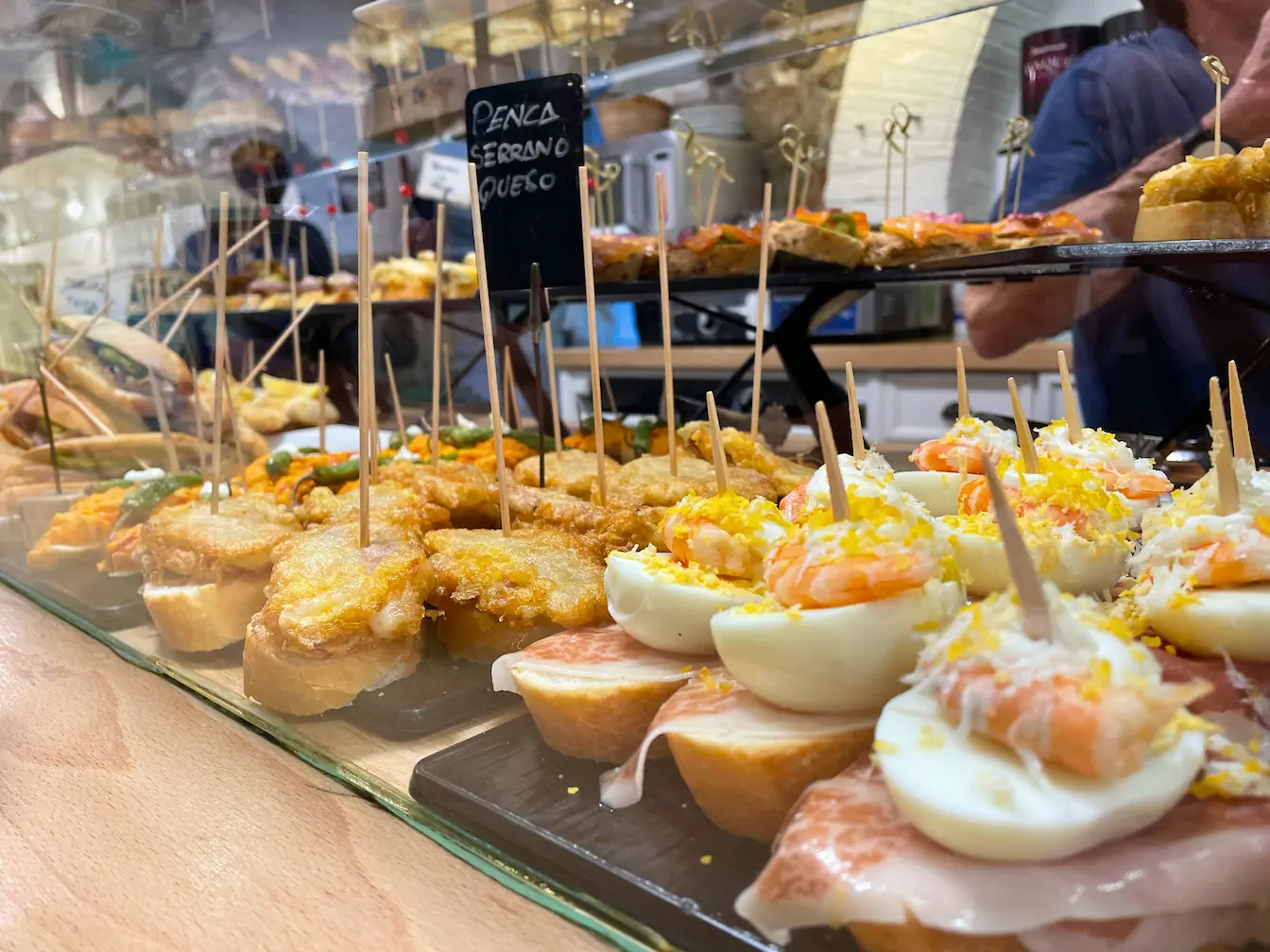
Pintxos in San Sebastián: The Best Bars and What to Order


You’ve probably heard that San Sebastián is a food lover’s paradise, but why exactly? For starters, it’s one of the cities with the most Michelin stars per person in the world. But beyond the fine dining, what truly makes it special is the sheer number of high-quality, affordable bars, and that’s where pintxos in San Sebastián come in: the Old Town alone has more than a hundred bars, most of them pintxo bars, serving everything from simple, traditional bites to inventive, modern creations.
We spent a day here in September 2023 with one goal: to try as many different dishes as possible. For the pintxos we had something better than a tour: a friend born and raised in San Sebastián sent us to three bars, with what to order at each. (Our guided food tour was in Bilbao.) Here’s what pintxos are, whether a tour is worth it, how to pick a good bar, our friend’s three, and where the burnt cheesecake began.
👉 One Day in San Sebastián: the rest of our day, from Mount Igueldo to the sunset on La Concha
👉 Our 5-day Basque Country itinerary: San Sebastián is Day 4, with Bilbao and the coast around it
👉 Staying the night? The Old Town puts you right among the bars

Planning a family trip in Europe?
From Lapland to the Black Sea, we know what works with little ones. Skip the research: tell us your dates and what you have in mind, and we’ll plan the rest.
Plans from $189
What You'll Find In This Post:
Prices and opening hours are for 2027 trips, checked in November 2026.
What Are Pintxos?
Pintxos (pronounced pinchos) are small snacks of different local ingredients, traditionally held together with a skewer or toothpick on a slice of bread. They’re usually eaten in a few bites, with no cutlery needed.
Pintxos are a big part of the social culture in the Basque Country: people usually snack on them while hanging out with friends.
They first appeared in the 1930s and 40s in a bar in San Sebastián. The owner wanted to attract more customers with small, appealing appetisers set out on the counter. It worked so well that many other bars started offering them too, and pintxos quickly became the essence of the local cuisine.

What Is the Difference Between Pintxos and Tapas?
Pintxos are often described as the Basque version of tapas, but they’re not quite the same. Here’s a quick comparison:
| Feature | Tapas | Pintxos |
|---|---|---|
| Region | All over Spain | Primarily the Basque Country |
| When eaten | Typically during lunch or dinner | Any time of day |
| How they’re eaten | Usually seated, with drinks | Often standing, eaten quickly or on the go |
| Presentation | Often simple, served on a plate | Usually served on bread, often skewered with a toothpick |
| Ingredients | Usually one main ingredient | More elaborate, combining several ingredients |
| Preparation | Relatively simple | Can involve more complex techniques and creativity |
Pintxos offer a unique and creative culinary experience. They’re not just snacks: they’re little bites of art designed to surprise your taste buds. So when in San Sebastián, don’t just think tapas. Go for pintxos!
Should You Do a Pintxo Tour in San Sebastián?
A pintxo tour is a great way to dive deeper into the local flavours and culture. It offers more than just food, though: it’s also about the experience. You spend the evening with a local guide, learning about Basque culture, food traditions and wine in a much more personal way.
We find some of the tours a bit pricey: the one we’d book is about €100 a person, and others cost more, when most pintxos cost €4–5 each on our trip in September 2023.
How it went for us: We did our food tour in Bilbao, where we were based, and we genuinely loved it. Our guide shared so many insights we would never have picked up on our own.
In San Sebastián we had our friend’s tips instead. Without inside information like that, a guided tour is a must here, and a great way to get oriented, especially on your first visit.
You don’t need a food tour in every Basque city, though: one well-chosen tour is enough to give you a solid introduction to pintxo culture.
The San Sebastián pintxo tour we’d book
Devour’s Pintxos and Wine Tour is about three hours in the Old Town in the evening with a local guide: eight pintxos and four drinks, with stops that include Txepetxa and La Viña, both in this guide.
It meets behind the town hall, and you can cancel for free up to 24 hours before. It isn’t recommended for children under 15.
What to Order: Traditional Pintxo Ingredients
Every town in the Basque Country has its own signature pintxos, unique local creations you often won’t find anywhere else, and San Sebastián, the birthplace of pintxos, is no exception. Still, a few classic ingredients show up again and again:
Sardines and anchovies: staples of Basque cuisine. In fact, one of the best bars in San Sebastián is famous for its anchovy pintxos, more on that below.
Crab paste: this creamy, delicate crab mixture is a local favourite, especially with people who aren’t usually into seafood. It’s smooth, lightly seasoned and surprisingly mild. We loved it!
Croquetas (croquettes): a pintxo bar classic, in all kinds of variations: filled with cheese, vegetables, ham, seafood or meat. Crispy on the outside, melty on the inside, and a must-try.
Bacalao (salt cod): another staple of Basque cuisine. You’ll often see it on a slice of bread with pil-pil sauce (a garlicky olive oil emulsion) or topped with roasted red peppers.

Quail egg (huevo de codorniz): often used to top meat or vegetable pintxos, for extra richness and a bit of colour.
Piquillo peppers: sweet roasted red peppers, often stuffed with cheese, seafood or meat. You’ll see them in many pintxo combinations.

It’s the perfect place to be adventurous and try things you normally wouldn’t; you might be surprised by what you end up loving. Even picky eaters will find something, because when dishes are made with great ingredients, even the simplest ones shine.
How to Choose a Good Pintxo Bar: 3 Tips
With so many pintxo bars in San Sebastián, knowing where to go can be overwhelming, especially on your first visit. To avoid tourist traps and find the truly authentic spots, here are three tried-and-tested tips:
1. Follow the Locals
The best sign of a good pintxo bar? It’s packed with locals. If a bar is buzzing with people, especially people speaking Spanish or Basque, it’s likely a trusted favourite. Locals know where the best bites are, so follow their lead.
2. Avoid Empty Bars (Even If They Have Good Reviews)
We’ve made this mistake before: choosing a bar with solid online reviews, only to find it completely empty on a Friday night while every other place nearby was full. If a bar is quiet at peak times, there’s probably a reason. Trust the atmosphere over the algorithm.
3. Don’t Judge by Appearances
Some of the best pintxo bars in San Sebastián are tiny, unassuming places with plain interiors and barely any signage. Don’t be fooled: behind that humble counter might be some of the most delicious, expertly prepared food in the city. In fact, the more modest the place, the more likely you’re in for an authentic experience.
The Best Pintxo Bars in San Sebastián: Our Friend’s Three
With more than a hundred bars in the Old Town alone, it’s hard to say which ones are the best, especially since most of them are genuinely very good.
These three are our favourites, in no particular order, and all three came from our friend, born and raised in San Sebastián. Don’t hesitate to explore beyond them: keep the tips above in mind, and you’re likely to find some great spots of your own.
Gandarias
📍 31 de Agosto Kalea, 23 · 🕘 Open every day, with the kitchen open non-stop from 11:00 to midnight
Gandarias is one of the best-known pintxo bars in San Sebastián, and for good reason. It’s both a restaurant and a bar, with a fantastic variety of traditional pintxos on bread as well as hot small plates like the ones in the photo below.
It gets very busy, but don’t be discouraged: it’s usually possible to grab a table, as most people eat quickly and move on. You order at the bar, and there’s no formal queue, so just step up confidently when you’re ready. With kids, the tables and the all-day kitchen make it an easy choice for an early dinner, before most bars open for the evening.
How it went for us: The scallops were absolutely to die for, and the meat dishes were incredibly flavourful and juicy. There were so many other things we wanted to try: everything looked fresh, beautifully prepared and tempting. Definitely a place worth coming back to.

Bar Txepetxa
📍 Arrandegi Kalea, 5 · 🕘 Closed on Mondays and Sunday evenings
Txepetxa is a small but very popular bar, with just a few high tables outside. It’s always buzzing, so be prepared to work your way to the bar to order, but it’s well worth the effort. The staff are friendly and super helpful, which makes the experience even better.
They specialise in seafood pintxos, especially anchovies, and do it exceptionally well. It’s an award-winning bar, too: its anchovy with spider-crab cream won the city’s Gold Barandilla for the best pintxo in 2019, and in 2024 Txepetxa was named the best pintxo bar at the Basque Country and Navarre pintxo championship.
How it went for us: When we were there, a sign and the menu pointed to their latest prize-winning pintxo, and yes, you can order it and try it for yourself: we did, and it was absolutely worth it. The menu isn’t very long, so order whatever you like the sound of. We had quite a few things, and it was all good.
Don’t stop at just one: be sure to try some of their other anchovy specials. They’re fresh, creative and packed with flavour.

Borda Berri
📍 Fermin Calbeton Kalea, 12 · 🕘 Closed on Sundays and Mondays; lunch Wednesday to Saturday from 12:30, evenings Tuesday to Saturday from 19:30
Borda Berri is known for its creative takes on traditional pintxos, always made with the freshest local ingredients, and the selection is wide and varied, so there’s truly something for everyone, whatever your taste. The hot pintxos are cooked to order from the blackboard, and its risotto with Idiazabal cheese and its slow-braised meats are the dishes people come back for.
It tends to get crowded at peak times, so arriving 10–15 minutes before opening is a smart move if you want to beat the rush. We didn’t queue, and it was fine: the friendly staff manage the lively, often chaotic atmosphere impressively well, so even if you show up later, you should still be able to order without much of a wait.
Heading out for pintxos? The short version of this guide, on your phone. Free PDF 👇
Where to Try the Original Burnt Basque Cheesecake
📍 31 de Agosto Kalea, 3 · 🕘 Closed on Mondays
You’ve probably already heard of the famous Basque cheesecake, or you will the moment you arrive in San Sebastián, because it’s everywhere. This dessert has become popular far beyond Spain in recent years, with countless recipes and videos online in different languages. But nothing quite compares to the original.
The Burnt Basque Cheesecake was invented right here in the 1990s, at a small bar in the Old Town called La Viña. Its creator, Santiago Rivera, has always shared the recipe, but you can still try the original at La Viña itself. Today you’ll find this cheesecake in bars, restaurants and bakeries all over the city, but a visit to La Viña is a must for the real thing.

What Makes the San Sebastián Cheesecake So Special?
Unlike most cheesecakes, the Basque version has no crust: it’s all about the creamy centre. The texture is velvety, rich and soft in the middle, almost like a custard, and it truly melts in your mouth.
It’s not overly sweet, which makes it surprisingly light. The top and edges are baked to a deep golden brown, which gives it that signature “burnt” look and a slightly caramelised flavour.
How it went for us: We think the Burnt Basque Cheesecake is absolutely worth trying when you’re in San Sebastián. Is it the best cheesecake ever? We missed the crunch of a traditional base, but we’re still really glad we gave it a try. It’s a unique dessert with a flavour and texture all its own, and a true part of the city’s food culture.

Are There Any Vegetarian Pintxos?
Vegetarians often face some challenges when travelling in Spain, as many traditional dishes feature Iberian ham, other meats or seafood. The same holds true in the Basque Country, where pintxos typically focus on cured ham, anchovies and other local fish.
That said, you can still find meat-free pintxos if you know where to look. Two we had ourselves: cheese croquetas, creamy, comforting and delicious, and stuffed piquillo peppers, often filled with cheese or vegetables.
These bars in San Sebastián offer good vegetarian-friendly options; their TripAdvisor pages show menus and reviews:
It’s worth knowing that most vegetarian pintxos contain cheese or eggs, so vegan options can be quite hard to find. The pintxo scene is still very traditional, but that might begin to change in the coming years.

Final Thoughts: Is San Sebastián Worth It for the Food?
Yes, at almost any budget. It’s fair to say that in this guide, and even during our visit, we only managed to scratch the surface of San Sebastián’s food culture. The city’s Michelin-starred restaurants are worth exploring if you can splurge a bit, but you don’t need them to eat exceptionally well: some chefs who trained in those kitchens go on to open their own pintxo bars, bringing high-quality, inventive food to a more casual (and affordable) setting.
With a local’s tips, go it alone and bar-hop; without them, a tour is the easiest way into pintxos in San Sebastián. And don’t leave without a slice of La Viña’s cheesecake, even if, like us, you miss the crunch of a base.
Driving the coast too? Getaria’s main street was our other pintxo highlight: we went from bar to bar there and had the best seafood we’ve ever had. It’s in our day trips from San Sebastián.
We hope this guide gives you a great starting point for your own pintxo adventure. San Sebastián has so much to offer, so get out there, explore and, most importantly, enjoy every bite!
FAQ: Pintxos in San Sebastián
What is a pintxo?
A pintxo (pronounced peen-cho) is a small snack, usually served on bread and often held together with a toothpick. Pintxos are a Basque tradition, similar to tapas but usually more elaborate and creative; here’s how they differ.
What time do people eat pintxos in San Sebastián?
Locals eat pintxos throughout the day, but the busiest times are around 1–3 pm for lunch and 8–10 pm for dinner, when bars get very crowded. Most open for lunch around midday and again in the evening from about 7 pm. With kids, go when they open, before the crowds; Gandarias serves all day.
Do you sit down at pintxo bars?
Not always. Most pintxo bars are standing-room only, especially in the Old Town. It’s common to grab a bite and a drink at the bar, then move on to the next one.
Are there vegetarian pintxos available?
Yes, though options are limited: cheese croquetas and stuffed piquillo peppers are the easiest to find, and vegan pintxos are harder still. Our vegetarian section has a few bars to try.
Is a pintxo tour worth it?
If you don’t have a local’s tips, yes: it’s a great way to learn about the culture, discover local favourites and try dishes you might otherwise miss. We did ours in Bilbao and loved it; in San Sebastián, this is the pintxo tour we’d book.
Can I find Michelin-quality food without the high price tag?
Absolutely. Some pintxo bars are run by chefs who trained in Michelin-starred kitchens, so you can enjoy top-tier food at affordable prices all over the city.




One Comment
Comments are closed.